On most rate cards they sit next to each other and look like two versions of the same idea: pay something up front, come back more often. They are not the same idea at all. They make different promises, they behave differently on a busy evening, and they fail in different ways.
A pass is stored value
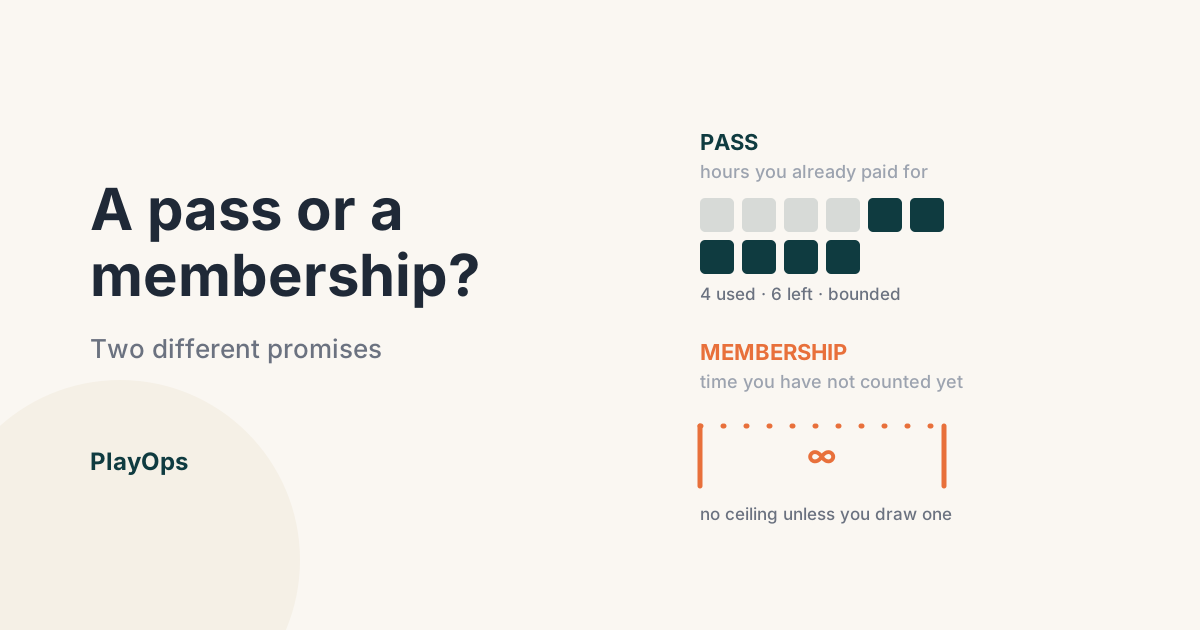
A family pays for ten hours and uses them across weeks. Each visit draws down the balance.
The promise is a discount for paying early. What you have sold is hours you already had.
- Cash arrives now, delivery is spread out.
- Every visit still costs the family something, so nothing is free at the door.
- An unused hour is yours. Passes expire, and most partly go unused.
- Your risk is small and bounded: you owe exactly the hours on the balance, and no more.
A membership is unlimited access
A family pays monthly and comes as often as they like.
The promise is the absence of a decision. What you have sold is not hours — it is the right to stop thinking about the price.
- Cash arrives regularly, which is better than lumpy.
- Nothing is charged at the door, so visit frequency has no ceiling.
- A member's cost to you rises the more they use it. The best customers are the most expensive ones.
- Your risk is open-ended unless the card puts a boundary on it.
These are not better and worse. They are different instruments. A pass sells value you already hold. A membership sells time you have not counted yet.
The 7pm problem
Here is where it stops being a philosophical difference.
We measured 185 play centres. Every single day of the week peaks at 7pm, and the evening block runs about twice as full as the morning. Your floor is not uniformly available — it has four hours a day that are genuinely scarce.
A member arriving at 7pm on a Saturday occupies your scarcest seat and pays nothing at the door. If the floor is full, you turn away a walk-in who would have paid full price. The membership did not add a customer that evening; it replaced a paying one.
A pass holder arriving at the same moment has just spent an hour of balance you were paid for weeks ago. The cash is already in the bank, and the hour still comes off the card.
So the honest rule is: if your evenings are already full, sell passes. Sell memberships to fill the hours nobody wants.
How to make a membership safe
If you want to sell one anyway — and there are good reasons to, because it is the strongest loyalty instrument you have — put a boundary on it. Any one of these is enough:
- Time-boxed. "Unlimited before 4pm." This is the cleanest version: it sells exactly the capacity you are struggling to fill, and it never touches 7pm.
- Visit-capped. "Up to 12 visits a month." Still feels generous; almost no family reaches it.
- Weekday-only, with weekends charged normally.
All three convert an open-ended promise into a countable one. And all three must be printed on the card — a boundary that lives only in the owner's head is not a boundary, it is a future argument.
The part that actually breaks
Whichever you sell, it fails the same way: the tracking.
A pass is a balance that must be right every time, at a busy counter, often handled by staff who did not sell it. On paper this is a register that goes missing, a ledger nobody wrote in on Sunday, or a photographed card in a WhatsApp thread. The failure is not dramatic — it is one hour, unrecorded, in the family's favour, repeatedly.
That is why most centres that talk about launching a pass never do. Not because the pricing is hard, but because they know what will happen to the tracking by month three. The pricing question is worth an evening of thought. The tracking question decides whether the answer survives contact with a Saturday.
What to do this week
- Write down which one you are actually selling. If you say "membership" but deduct hours, you are selling a pass.
- If you sell a membership, write its boundary on the card today — hours, visits, or days.
- Ask what happens when a member arrives at a full 7pm floor. If you do not have an answer, that is the thing to decide before you sell another one.
Where PlayOps fits
Both instruments live or die on the counting, which is exactly what we built first.
On PlayOps a pass is an hour bank. The family buys ten hours; the wallet counts the minutes down by itself as the child plays, and the balance reads "8 hrs 45 mins" to anyone at the desk. Nobody hunts for a punch card. Memberships are plans on the same screen, so a member admits like anyone else and the visit still gets recorded — which means you can see, at the end of a month, what your members actually cost you in floor time.
The pricing question is worth an evening of thought. The counting question is what decides whether your answer survives a Saturday.